Introduction
Here’s a stat that might surprise you: HR outsourcing is projected to reach $45.8 billion globally by 2030 (Grand View Research). Yet, according to Deloitte’s Global Outsourcing Survey, 57% of executives admit they often miscalculate the true ROI of outsourcing either underestimating hidden costs or overvaluing the short-term savings.
That’s the catch. On paper, outsourcing looks like a magic bullet: faster hires, lower upfront investment, less internal bandwidth consumed. But when you dig into the numbers, really dig, you’ll often find that the ROI picture isn’t so simple.
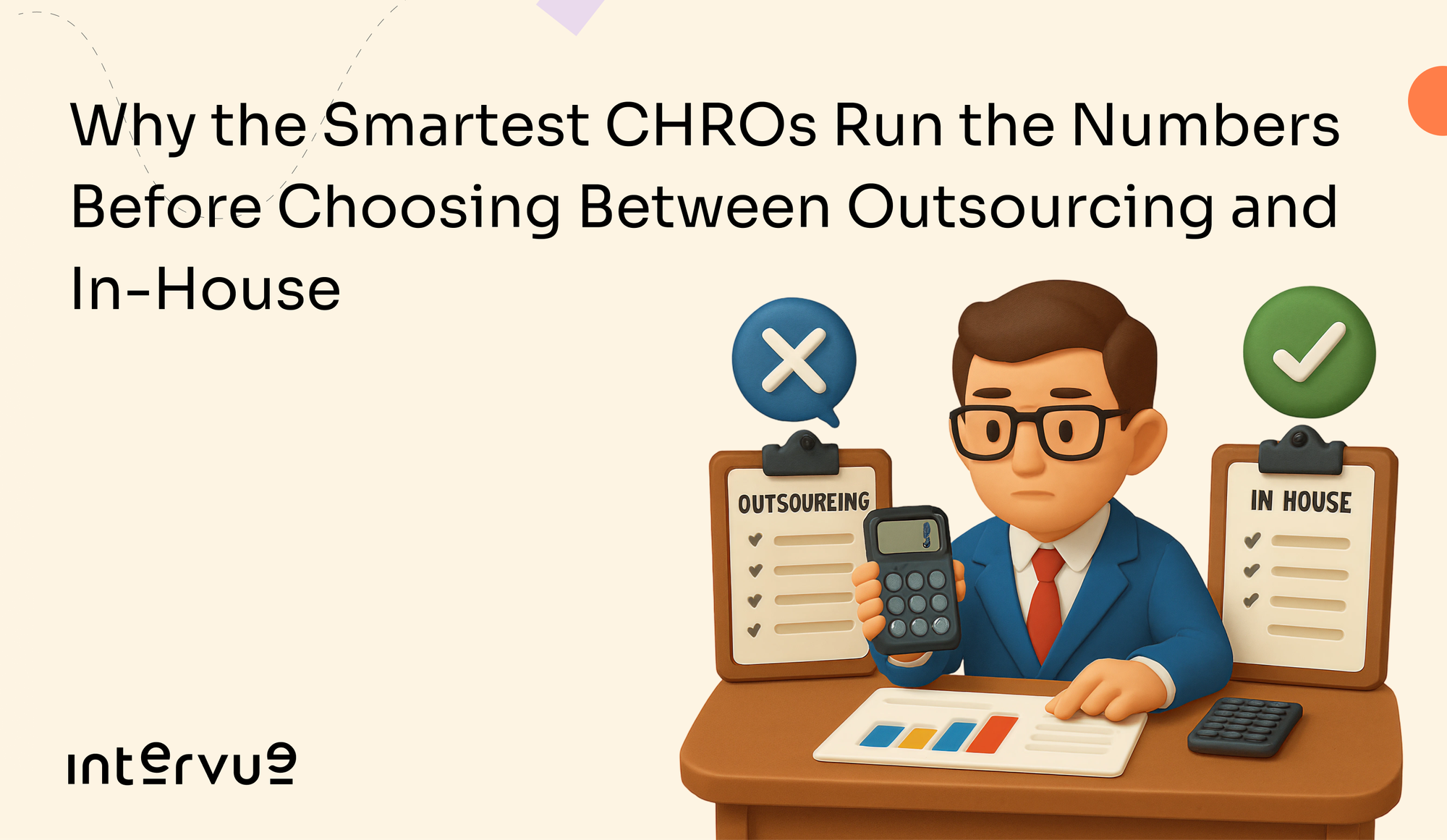
That’s why the smartest CHROs don’t get swayed by vendor promises or knee-jerk in-house loyalty. They run the numbers. Because choosing between outsourcing and in-house hiring isn’t just a budget decision. It’s a talent strategy decision, one that impacts speed-to-hire, quality-of-hire, retention, and ultimately business performance.
At Intervue, we sit at the intersection of both worlds, helping organizations accelerate hiring whether they lean in-house or partner with external interview panels. And if there’s one lesson we’ve learned, it’s this: ROI should be the compass, not cost alone.
The False Economy of Outsourcing
Let’s start with the appeal of outsourcing.
- It’s fast.
- It frees up your team.
- You get instant access to external expertise.
For lean HR teams, that’s tempting. But here’s the flip side:
- Hidden costs creep in. Beyond vendor fees, you pay for onboarding time, knowledge transfer, and sometimes even rework if quality doesn’t meet standards. According to Bersin, bad hires cost companies 30% of the employee’s annual salary.
- Loss of control. Outsourced partners don’t always mirror your culture, brand voice, or candidate experience. That misalignment can hurt long-term retention—an often-overlooked ROI metric.
- Scalability mismatch. If your hiring surges or dips, outsourced arrangements can feel either too expensive (when volume is low) or too slow (when volume spikes).
It’s what we call the false economy: outsourcing looks cheaper upfront but can cost you more in the long run when attrition, mis-hires, and brand dilution are factored in.
The In-House Advantage (and Its Price Tag)
On the other side, building an in-house hiring engine gives you:
- Full control over process, candidate experience, and employer brand.
- Deeper alignment with hiring managers and business strategy.
- Long-term scalability if you expect continuous hiring.
But let’s be real: it’s not cheap. SHRM reports the average cost per hire in the U.S. is $4,700, and for technical roles, it often climbs past $10,000. Add to that recruiter salaries, tools, and training, and suddenly your internal engine is a significant fixed cost.
The ROI question here becomes: Is the investment justified by the quality, retention, and business impact of hires?
If yes, the ROI snowballs over time. If not, you’re carrying heavy overhead without the returns.
The Smart CHRO’s Math
Here’s where top CHROs separate themselves: they don’t look at outsourcing vs. in-house as binary. They build ROI models across four key dimensions:
1. Speed-to-Hire
- Outsourcing often wins short bursts (e.g., scaling up 50 engineers in 90 days).
- In-house shines for continuous hiring where processes improve over time.
2. Quality-of-Hire
- This is where shortcuts kill ROI. A bad engineering hire can delay product launches by months.
- In-house recruiters, steeped in your culture and tech stack, tend to filter better.
- Outsourcing can win if the partner provides domain experts (e.g., Intervue’s external engineering interviewers).
3. Retention & Engagement
- Gallup estimates the cost of replacing an employee at 150% of the employee's salary.
- CHROs factor in not just the hire, but whether that hire will stay.
- In-house processes often create stronger candidate experience and alignment.
4. Total Cost of Ownership (TCO)
- Smart CHROs calculate all costs: vendor fees, internal recruiter salaries, tech tools, training, onboarding, and rehiring costs.
- They map these costs against metrics like productivity per hire and revenue impact.
Why ROI Beats Gut Feel
Here’s the truth: many hiring decisions still get made on gut feel. A CEO says, “Outsource, it’s faster.” A TA head says, “No, we’ll build in-house, it’s safer.”
But in 2025, gut feel doesn’t cut it. Budgets are tight. Talent is scarce. And leadership wants to see the business case.
According to PwC’s HR Tech Survey, it indicates that over 70% of surveyed HR professionals expect to invest more in HR technology in the coming years. In other words, running the numbers isn’t just good practice; it’s a political advantage.
Intervue’s POV: A Hybrid Model is the Future
From where we sit, the answer isn’t outsourcing or in-house. It’s both, but strategically.
- Outsource selectively. Use external panels for specialized interviews or when your internal bandwidth is stretched. That’s exactly what Intervue does: plug-and-play expert interviewers for technical roles.
- Build in-house where it matters. Own your core recruiting engine, especially for culture-heavy roles and long-term talent needs.
- Measure everything. Whether in-house or outsourced, track metrics like time-to-hire, quality scores, candidate experience, and retention rates.
This hybrid, ROI-driven approach lets you stay lean without sacrificing quality.
Takeaway for CHROs
If you’re a CHRO or TA leader staring at the outsourcing vs. in-house decision, here’s the bottom line: don’t guess. Run the numbers.
- Compare not just costs, but returns across speed, quality, retention, and total ownership.
- Present those numbers to your leadership team.
- And don’t be afraid to mix models. The smartest companies already are.
At Intervue, we’ve seen this play out across fintech, BFSI, consumer tech, and enterprises. The organizations that win aren’t the ones who outsource blindly or build everything internally. They’re the ones who ask: “Where does outsourcing boost ROI, and where does in-house multiply it?”
That’s the real question. And when you run the math, the answer gets a whole lot clearer.
Final Word
The future of hiring isn’t binary. It’s about making ROI the north star of your talent strategy.
So the next time someone asks you, “Should we outsource or build in-house?” don’t answer right away. Smile, and say:
“Let’s run the numbers first.”