Introduction
Scaling a tech team is one of the hardest balancing acts in business. Move too slowly, and you lose candidates to competitors. Move too fast, and you risk costly mis-hires. For engineering leaders, the interview process is where this balance plays out most intensely.
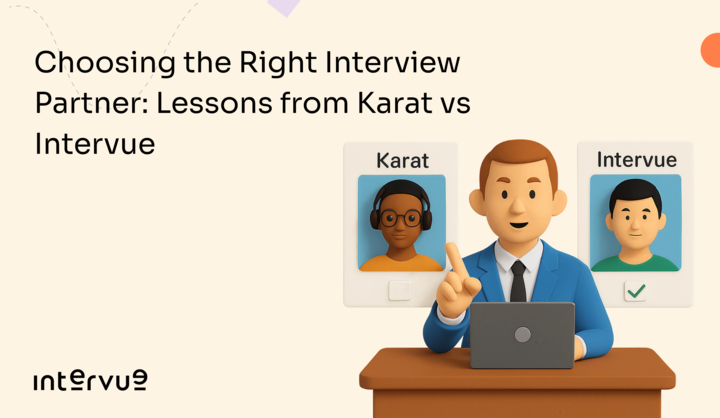
That’s why many companies turn to interview platforms like Karat and Intervue. On paper, both aim to solve the same pain: freeing up engineering bandwidth while ensuring consistent, high-quality interviews. But dig deeper, and the differences start to matter—especially if you’re a team that’s growing at breakneck speed.
This blog explores where Karat excels, where it falls short, and why more fast-scaling teams are choosing Intervue as the platform built for speed, fairness, and control.
The Real Stakes of Technical Interviews
Before we compare solutions, let’s zoom in on what’s at stake in fast-growth hiring:
- Time-to-hire: Every extra day in the hiring cycle increases the odds of losing a great candidate. According to LinkedIn, the average hiring process for tech roles takes 44 days—and top candidates are often off the market in 10. That gap is where companies bleed talent.
- Engineering bandwidth: Senior engineers are expensive. If they spend dozens of hours each month on preliminary interviews, your product roadmap slows down.
- Consistency and fairness: Unstructured interviews are notoriously unreliable. Research from Google’s People Analytics team shows that unstructured interviews predict job success about as well as random chance. Without rubrics and structure, bias creeps in.
- Candidate experience: In competitive markets, a poor interview experience can ruin your employer brand. Nearly 83% of candidatestowards an enterprise-heavy, structured, and benchmark-driven approach say a negative interview experience can make them reject an offer, even if the job is a fit.
With those factors in mind, let’s break down Karat and Intervue.
What Karat Brings to the Table
Karat is a well-known name in enterprise hiring. Its model is straightforward: outsource interviews to a network of Interview Engineers, technical professionals trained to deliver consistent early-round interviews.
The upsides are clear:
- Credibility: Karat has built trust with large enterprises. Its data and benchmarks across roles and geographies appeal to organizations hiring at scale.
- Consistency: External interviewers help standardize early-round assessments, reducing reliance on ad-hoc internal panels.
- Capacity: By offloading interviews, companies can save significant engineering hours and prevent burnout on their in-house teams.
But Karat’s model also introduces challenges, particularly for companies scaling fast:
- Higher cost: Paying for external interview engineers at scale can drive up per-interview costs quickly.
- Slower cycles: Scheduling with third-party interviewers often adds friction, stretching feedback loops.
- Limited flexibility: Customizing interview rubrics or tailoring formats can be rigid or come with extra cost.
- Variable candidate experience: Even with training, interviewer styles differ. Some candidates report inconsistency in depth, tone, or follow-up.
For large enterprises with deep budgets and long hiring horizons, those tradeoffs may be acceptable. But for teams growing fast, they can be bottlenecks.
How Intervue Was Built Differently
Intervue was designed for teams that don’t have the luxury of slow cycles or ballooning costs. The platform blends structured assessments, expert-led interviews, and process automation into a system that is both scalable and agile.
Here’s how Intervue shifts the equation:
1. Faster Hiring Cycles
Intervue delivers detailed reports within 120 minutes of an interview ending. That speed is game-changing when the average candidate waits days (sometimes weeks) for feedback.
The results speak for themselves: clients report reducing time-to-hire by as much as 50%, shrinking six-week cycles into three. In markets where candidates juggle multiple offers, this speed keeps pipelines intact.
2. Smarter Use of Engineering Bandwidth
Instead of overburdening in-house engineers, Intervue offers on-demand external interviewers who specialize in roles like backend, frontend, data science, or DevOps. Internal teams only step in where it matters most—later rounds where cultural and product alignment are key.
The impact? Companies save up to 80% of scheduling and coordination time, freeing their best engineers to focus on building, not screening.
3. Structured, Rubric-Driven Assessments
With over 8,000 rubrics across 500+ skills, Intervue ensures every candidate is evaluated against consistent, role-specific benchmarks. No more subjective gut calls or inconsistent questioning.
This not only improves prediction accuracy but also reduces bias—a key concern as teams scale globally and hire diverse talent.
4. Candidate-Centric Experience
Every candidate interacts with a live coding environment, smooth video/audio, and interviewers whose credentials are visible upfront. Sessions are recorded for transparency, and feedback is clear and actionable.
For candidates, this builds trust. For hiring teams, it builds brand equity. In competitive tech markets, that edge can mean the difference between an offer accepted and an offer declined.
5. Scalable Cost Efficiency
Unlike one-size-fits-all vendors, Intervue’s modular design means you pay for what you need—whether it’s technical assessments, external interviewers, or structured rubrics. The result is a cost curve that scales with you, not against you.
For growth-stage companies watching every dollar, that’s not just nice-to-have. It’s essential.
The Intervue vs Karat Difference in Action
Here’s what it looks like when the two models play out in real hiring scenarios:
- Feedback speed: With Karat, turnaround can stretch because reports route through external scheduling and processing. With Intervue, you get a report in hours, not days.
- Flexibility: Karat offers strong benchmarks but less room for tailoring. Intervue lets you define role-specific rubrics and customize down to sub-skills.
- Candidate trust: Karat interview quality is solid, but styles vary by engineer. Intervue emphasizes transparency—credentials, recordings, structured feedback—so candidates know they’re in good hands.
- Scalability: Karat’s per-interview costs scale up quickly with volume. Intervue’s modular approach ensures cost efficiency even when hiring surges.
For a hypergrowth startup or a scaling enterprise unit, these differences aren’t cosmetic. They directly impact whether you can hire the right people before your competition does.
When Karat Might Still Make Sense
To be clear, Karat has strengths. If you’re a Fortune 500 with large budgets, long hiring horizons, and a need for extensive benchmarking across regions, Karat’s global footprint and established credibility may appeal.
But if speed, flexibility, and candidate experience are your priorities, Intervue is built for you.
Why Fast-Growing Teams Choose Intervue
At its core, the decision comes down to what kind of hiring challenge you face:
- If you’re scaling fast, you can’t afford delays. Intervue’s two-hour feedback loop and streamlined scheduling keep your funnel moving.
- If your engineers are stretched thin, Intervue’s on-demand experts give you back bandwidth.
- If you care about fairness and predictability, Intervue’s structured rubrics cut through bias and guesswork.
- If candidate experience matters to your brand, Intervue makes the process transparent and respectful, improving offer acceptance.
- If costs need to scale efficiently, Intervue helps you grow hiring capacity without runaway spend.
In short: Karat is the established player. Intervue is the platform designed for speed, fairness, and growth.
Final Word
The hiring market doesn’t wait. Candidates don’t wait. And if you’re building fast, you can’t either.
Karat and Intervue both aim to solve the problem of technical interviewing, but their approaches differ. Karat leans towards an enterprise-heavy, structured, and benchmark-driven approach. Intervue is built agile, modular, and candidate-first.
For fast-growing tech teams, the choice is clear: Intervue isn’t just another alternative. It’s the platform built to make hiring fast, fair, and scalable!